{{ entry.club }}
{{ entry.country }}
{{ entry.owner }}
{{ curr(entry.net) }}
{{ curr(entry.spend) }}
{{ entry.change }}
{{ entry.high }}

For many billionaires, football club ownership is seen as an attractive investment opportunity.
But while the new owners can expect impressive returns, what benefit does the club and its fans get to enjoy?
To find out, we looked at 30 different football clubs with billionaire owners, spread across Europe’s top five leagues. We’ve then analysed each team’s performance before and after the takeover, tracking just how much money has been spent and what results this has led to.
Click on a team for more information.
According to our research, European football clubs see their annual transfer budget increase by an average of £23.3 million after being taken over by a billionaire.
However, not all teams see their transfer budget increase. In fact, 30% of the clubs in our study saw a reduction in their net spend, with this figure dropping to 25% when focussing just on Premier League clubs.
Manchester City saw the biggest boost to their average net spend following Sheikh Mansour’s takeover, with their transfer budget increased by an additional £89 million.
AC Milan saw the second highest increase, with a £78.9 million increase in their average annual net spend under Elliott Management.
At the other end of the table, Hoffenheim saw the sharpest fall in transfer budgets, with their average annual net spend dropping by £19.5 million since Dietmar Hopp became the club’s majority owner in 2015.
Newcastle United have seen the second largest decrease in transfer budgets, with their average annual net spend falling by £7.9 million under Mike Ashley’s ownership.
Only 59% of clubs show an improvement in their average league position after being taken over by billionaire owners, with 7% remaining the same and 34% seeing a drop in position. The average position increase following a billionaire takeover was just 2 places.
Out of all the teams we looked at, RB Leipzig enjoyed the biggest improvement in position, moving 278 places under Dietrich Mateschitz’s ownership. In just eight years they climbed up the German league pyramid from the NOFV-Oberliga Süd to the Bundesliga.
Sassuolo saw the second biggest ranking increase, climbing 96 places, from Serie C2 to Serie A, in 11 years.
Over in the Premier League, Leicester City enjoyed the biggest boost, climbing 22 places under Vichai and Aiyawatt Srivaddhanaprabha, eventually being crowned Premier League champions in 2016.
Fulham experienced the worst performance following their takeover by Shahid Khan, dropping 17 places, followed by West Bromwich Albion, who dropped 17 places under Lai Guochuan.
Southampton and Newcastle United, who both featured in the bottom five clubs for net transfer spend, both dropped six positions in the years following their big money takeovers.
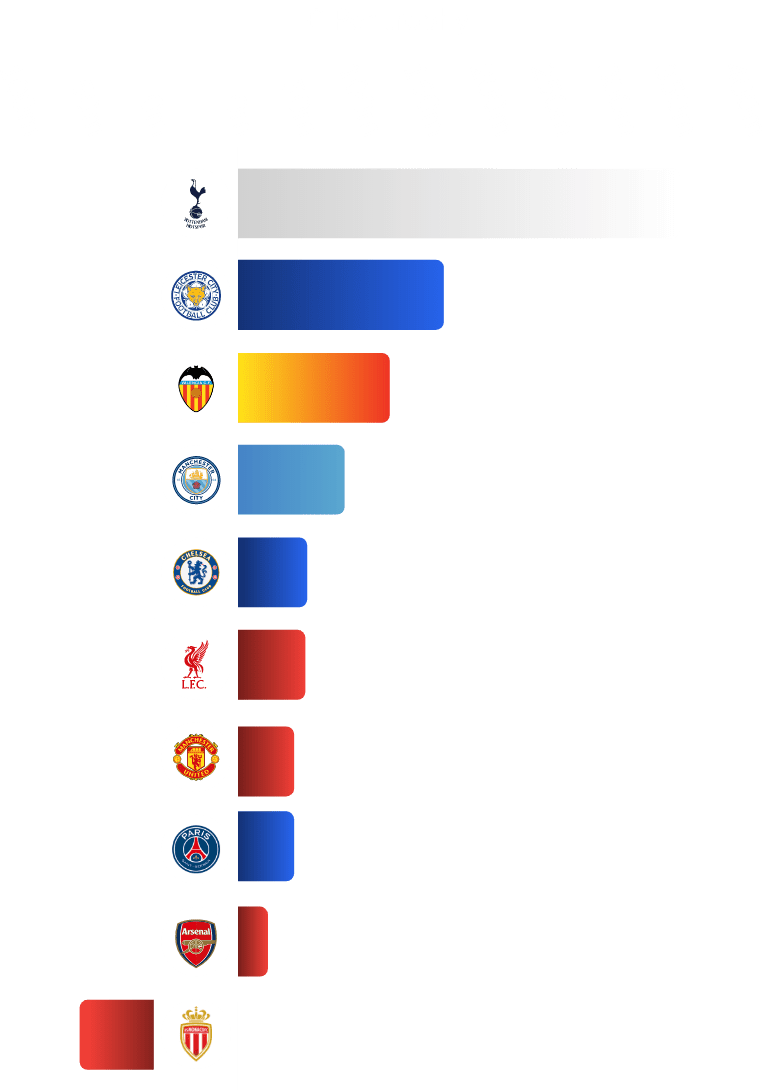
Finally, we looked at the average investment made by trophy winning clubs following a billionaire takeover, to calculate the price of success.
Looking across the top five European leagues, the average spend involved with winning a trophy was £50.8 million. However, when looking just at English sides, the average cost of a major trophy, including European competitions, was £59.5 million.
AS Monaco were the most financially efficient trophy winners in our study, with a net spend of -£60.6 million for their Ligue 1 title. Arsenal took the number two spot, with an average net spend of £22.4 million per trophy, followed by PSG with £29.2 million per trophy.
Tottenham Hotspur racked up the highest bill, with a net spend of £349.7 million per trophy, followed by Leicester City with £163.6 million. Valencia CF followed in third, with a net spend of £117.4 million per trophy.
Vanquis Bank are an award-winning bank and part of the Provident Financial Group. Offering credit cards for bad credit with an option of an eligibility check that won’t affect your credit score, be sure to visit our website and apply for a credit card today. Representative 39.9% APR (variable)
Figures relating to club performance and financial expenditure is accurate as of the end of the 19/20 season for each league. Averages for league position and net spend were calculated for the 5 seasons prior to takeover. All finances for transfer data were taken from transfermarkt.com. Estimated net worth figures accurate as of October 2020. For the purposes of this piece, the ‘takeover’ date was the date at which the owners took a majority stake in the club, rather than when they first started investing.